> ## Documentation Index
> Fetch the complete documentation index at: https://docs.cxp.crescendo.ai/llms.txt
> Use this file to discover all available pages before exploring further.
# Authenticated chat widgets
> Require customer sign-in before web chat, restore a login, and manage chat across tabs.
Use an authenticated CXP widget when customers must sign in before they can
connect to chat. Your CXP administrator must enable authentication for the
published Concierge Agent and allow the exact origin of your website. A draft
preview uses the published authentication policy.
## Before you enable authentication
Coordinate activation with your CXP operator. You need a supported widget build,
a configured customer identity tenant with at least one enabled supported login method,
and an approved list of HTTPS website origins. The authentication service and
chat runtime must be deployed before publishing the protected configuration.
Authentication is optional; existing widgets remain anonymous when the published
configuration does not enable it.
The widget discovers the authentication service through its chat settings response.
You do not need authentication configuration on your website server or a separate
widget build for each environment. If service configuration changes, customers
may need to sign in again.
## Sign in to chat
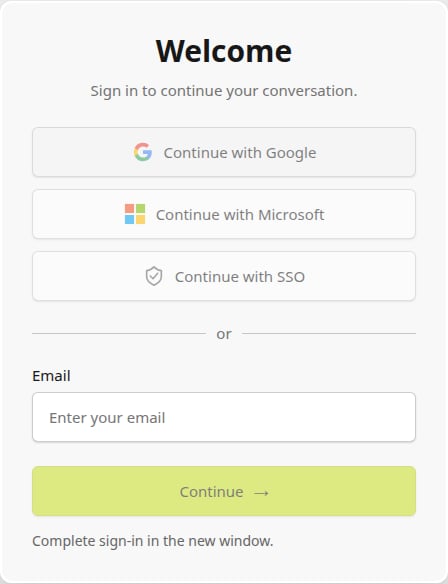
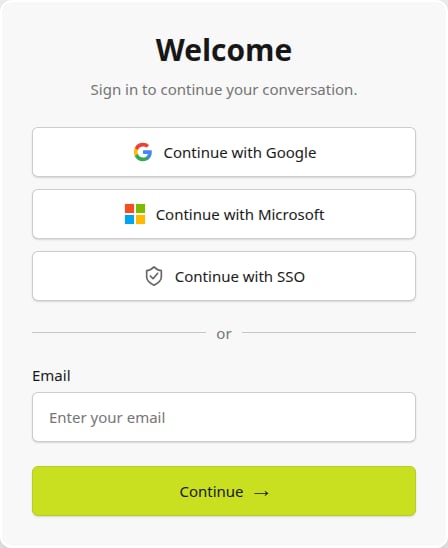
Select **Log in** in the widget. The popup offers the methods enabled in your
configured customer identity tenant:
* **Continue with Google** for the tenant's native Google provider.
* **Continue with Microsoft** for the native Microsoft provider.
* **Continue with SSO** for corporate OIDC or SAML. If several corporate
providers are enabled, choose one on the next screen.
* **Email → Continue → Password → Sign in** for email/password accounts.
Use **Forgot password?** to request reset instructions.
Google, Microsoft and SSO open a second window for your identity provider while
the Welcome window waits. Finish signing in there; both authentication windows
close after success and the widget connects. Email/password stays in Welcome.
If the provider window is blocked, allow popups for the sign-in site and try
again. If you close it or cancel, return to Welcome and choose a method again.
 Customers do not need a CXP account, organization membership or agent role. A
corporate provider can admit your entire workforce to chat while CXP access
remains limited to your configured CXP users. First-time federated users may
chat when the provider admits them. Email/password uses an existing identity
account; the popup does not offer account registration.
Only enabled supported methods appear. All custom OIDC/SAML configurations,
including Google-backed OIDC providers, appear under **SSO** and use their
configured provider IDs. Authentication remains within the configured
customer tenant and does not create a CXP user.
Customers do not need a CXP account, organization membership or agent role. A
corporate provider can admit your entire workforce to chat while CXP access
remains limited to your configured CXP users. First-time federated users may
chat when the provider admits them. Email/password uses an existing identity
account; the popup does not offer account registration.
Only enabled supported methods appear. All custom OIDC/SAML configurations,
including Google-backed OIDC providers, appear under **SSO** and use their
configured provider IDs. Authentication remains within the configured
customer tenant and does not create a CXP user.
 ## Sign in and resume chat
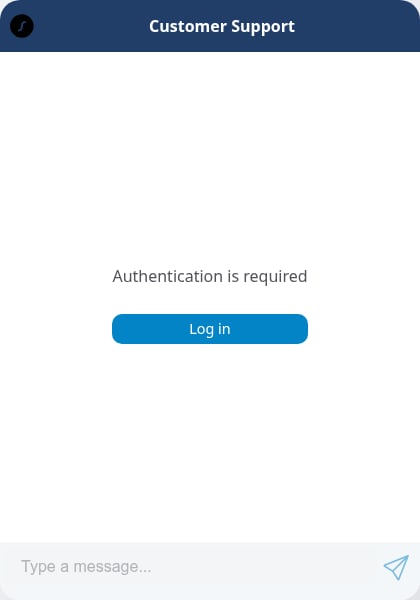
The widget shows **Authentication is required** until you select **Log in** and
finish signing in in the popup. Allow popups for your website. Conversation
content and startup forms appear only after authentication succeeds.
## Sign in and resume chat
The widget shows **Authentication is required** until you select **Log in** and
finish signing in in the popup. Allow popups for your website. Conversation
content and startup forms appear only after authentication succeeds.
 A supported browser can restore the same login and chat after a page reload or
browser restart. Restoration requires the same browser profile, website origin,
widget configuration and an unexpired login. Clearing site data, private browsing
or blocked browser storage can prevent restoration. A login lasts up to seven
days; you may need to sign in sooner if access is revoked or configuration changes.
If the widget reports that authentication is unavailable, enable browser storage
and use a browser that supports Web Locks, then select **Retry**. Anonymous
widgets do not require these authentication storage features.
If the popup reports that sign-in could not be completed, close it and start a
fresh login. For developer troubleshooting, the popup console's **Widget sign-in
failed** entry includes a stage and error code that you can share with your CXP
operator. Do not share account credentials, tokens or authentication URLs.
## Continue in another tab
When another tab takes over the same chat, this tab pauses. Select **Continue in
this tab** to use it again. Switching tabs alone does not send a pending message.
If the widget says a message was not sent, send it again after continuing.
Starting a new chat keeps the same valid login. Another open tab adopts the new
chat and remains paused until you choose to continue there.
## Log out
Select **Log out** to clear the widget's local authentication and conversation
state and request revocation of the login. If local cleanup fails, the widget
blocks chat and offers **Retry log out**. Logging out of the widget does not sign
you out of the website or your identity provider.
Widgets share browser storage for a website origin. Only one authentication
scope is retained at a time. Use separate browser profiles for different people
on a shared device: existing transcript and context storage is not a privacy
boundary between people or simultaneously active tabs.
## Host-page integration
A host application may provide a current Firebase ID token before the user
selects **Log in**:
```javascript theme={null}
const widget = document.querySelector('enegelai-bot');
widget.setAuthenticationToken(firebaseIdToken);
```
CXP verifies this token and its organization before using the existing host
session. An absent, invalid or mismatched token falls back to customer sign-in.
The setter keeps the token only in memory; it does not initiate login. Pass
`null` when your application no longer wants to provide a host token.
You can also request logout from the host page:
```javascript theme={null}
const result = await widget.logoutAuthentication();
// result.localCleanup: 'complete' | 'incomplete'
// result.serverRevocation: 'complete' | 'failed' | 'not_attempted'
```
Available sign-in name and email values enter the widget through ordinary
context once on login or restoration. Your existing `setContext` calls remain
editable; these values are not an identity assertion for contact matching.
Never collect tokens, callback URLs or chat connection URLs in analytics. For
support, use the non-secret support reference from widget authentication events.
A supported browser can restore the same login and chat after a page reload or
browser restart. Restoration requires the same browser profile, website origin,
widget configuration and an unexpired login. Clearing site data, private browsing
or blocked browser storage can prevent restoration. A login lasts up to seven
days; you may need to sign in sooner if access is revoked or configuration changes.
If the widget reports that authentication is unavailable, enable browser storage
and use a browser that supports Web Locks, then select **Retry**. Anonymous
widgets do not require these authentication storage features.
If the popup reports that sign-in could not be completed, close it and start a
fresh login. For developer troubleshooting, the popup console's **Widget sign-in
failed** entry includes a stage and error code that you can share with your CXP
operator. Do not share account credentials, tokens or authentication URLs.
## Continue in another tab
When another tab takes over the same chat, this tab pauses. Select **Continue in
this tab** to use it again. Switching tabs alone does not send a pending message.
If the widget says a message was not sent, send it again after continuing.
Starting a new chat keeps the same valid login. Another open tab adopts the new
chat and remains paused until you choose to continue there.
## Log out
Select **Log out** to clear the widget's local authentication and conversation
state and request revocation of the login. If local cleanup fails, the widget
blocks chat and offers **Retry log out**. Logging out of the widget does not sign
you out of the website or your identity provider.
Widgets share browser storage for a website origin. Only one authentication
scope is retained at a time. Use separate browser profiles for different people
on a shared device: existing transcript and context storage is not a privacy
boundary between people or simultaneously active tabs.
## Host-page integration
A host application may provide a current Firebase ID token before the user
selects **Log in**:
```javascript theme={null}
const widget = document.querySelector('enegelai-bot');
widget.setAuthenticationToken(firebaseIdToken);
```
CXP verifies this token and its organization before using the existing host
session. An absent, invalid or mismatched token falls back to customer sign-in.
The setter keeps the token only in memory; it does not initiate login. Pass
`null` when your application no longer wants to provide a host token.
You can also request logout from the host page:
```javascript theme={null}
const result = await widget.logoutAuthentication();
// result.localCleanup: 'complete' | 'incomplete'
// result.serverRevocation: 'complete' | 'failed' | 'not_attempted'
```
Available sign-in name and email values enter the widget through ordinary
context once on login or restoration. Your existing `setContext` calls remain
editable; these values are not an identity assertion for contact matching.
Never collect tokens, callback URLs or chat connection URLs in analytics. For
support, use the non-secret support reference from widget authentication events.