

Teams, routing, and categories
Teams and categories control how CXP routes live customer work to the right group of agents.Prerequisites
You need an administrator, owner, or team-management role with permission to manage teams and routing settings.How routing fits together
CXP routing uses several pieces of configuration:- Teams group agents for ownership and routing.
- Categories classify what a conversation is about.
- Category mappings connect top-level categories to general teams.
- Routing policy decides how eligible agents receive work.
- Agent readiness determines who can receive live offers.
Team types
CXP includes a required All Agents team. This team represents the tenant-wide fallback pool and is system managed. Administrators can create general teams for operational groups such as Billing, Technical Support, or VIP Support. General teams can be mapped to top-level categories and can configure routing behavior.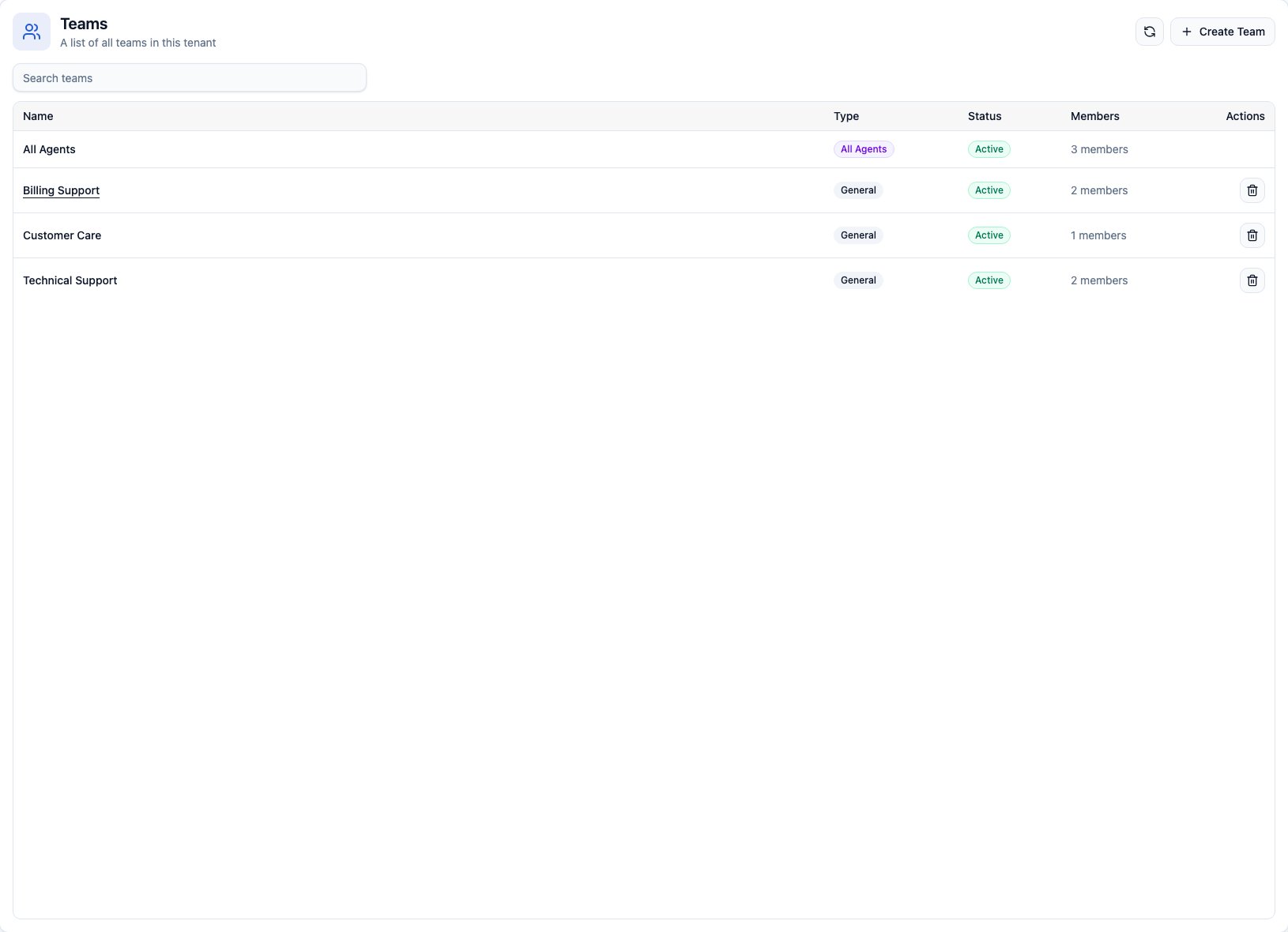
Manage team membership
From the Teams workspace, open a team to manage:- Team name and basic settings
- Active state
- Members
- Member routing eligibility
- Routing policy
- Category mappings
- Cascade routing, when enabled
- Team music settings for voice queues, when configured
Configure routing policy
Team routing policy controls how CXP selects an eligible agent. Supported policies include:- Round robin to rotate offers across eligible agents.
- Least loaded to prefer eligible agents with lower current load.
Configure tried-agent retry timing
Open Settings → Routing Management → Config and set Retry tried agents after in whole minutes. The default is 3 minutes, and the supported range is 1 to 1,440 minutes. When an agent declines an offer, an offer times out, or an administrator cancels an active offer, CXP temporarily excludes that agent from the same conversation. Reaching the configured time does not immediately create a new offer. The agent becomes eligible during the next ordinary routing pass. Use the queue’s Run action when you need an immediate pass. A saved change can take up to 60 seconds to reach every routing instance. It applies only to exclusions created afterward; existing retry times do not change.Configure queue recovery scan timing
Open Settings → Routing Management → Config and set Maximum Time Between Queue Routing Scans in whole seconds. The default is 60 seconds, and the supported range is 15 to 3,600 seconds. This setting is the maximum interval between scans of a non-empty queue for routing opportunities. Use a shorter value for faster scans or a longer value to reduce background scan frequency. Changes apply after the next scan.Manage categories
Administrators manage category catalogs in the Categories workspace. A catalog can contain a hierarchy such as:- Top-level category
- Subcategory
- Sub-subcategory
Map categories to teams
Map top-level categories to active general teams from team routing settings. When a conversation is categorized:- CXP identifies the top-level category.
- CXP checks whether that category maps to an active general team.
- If a mapping exists, the conversation routes to that team’s queue.
- If no valid mapping exists, the conversation routes to All Agents.
Configure cascade routing
Cascade routing can expand eligibility when work waits too long in a team queue. A general team can define stages such as:- Start cascade after a configured delay.
- Add one or more extension teams.
- Include All Agents as a later fallback stage.
Operational checks
Before enabling a new routing setup:- Confirm agents are active and assigned to the intended teams.
- Confirm agents can set themselves Ready.
- Confirm category mappings cover the intended work.
- Confirm unmapped work safely falls back to All Agents.
- Test a live chat or voice offer before relying on the configuration in production.