

Search and reporting
CXP includes Search and Reporting tools for finding historical conversations and reviewing operational performance. Expand Reporting in the sidebar to open Dashboard or, when your role permits it, Agent Workload.Search conversations
Use Search when you need to find conversations outside the active queue. Search supports:- Date range filtering
- Keyword search across conversation content and exact conversation IDs
- Status and priority filters
- Advanced natural-language search when enabled
- Generated query inspection when available
- Server-backed pagination and sorting
- CSV export for the current search when allowed
CX15 directly in keyword search. ID matching is case-insensitive.
For a quick lookup without leaving your current workspace, open Commands from the top of the sidebar or press Ctrl/Command+K. If your text does not match a navigation command, entering at least three characters searches conversations and shows up to ten recently updated matches. Select Search more … to open this page with the same keyword already applied and searched.
Use search responsibly
Search can expose customer history according to your permissions. Avoid exporting or sharing search results unless your role and tenant policy allow it.Dashboard
Use Dashboard to review support performance and AI Assistant behavior. Dashboard reporting can include:- Conversation volume
- Escalated conversation volume
- Time to agent
- Customer satisfaction estimates
- AI Assistant dashboard metrics
- Filterable charts and date ranges
Agent Workload
Owners and admins can open Reporting → Agent Workload to review current staffing and workload across the organization or one team.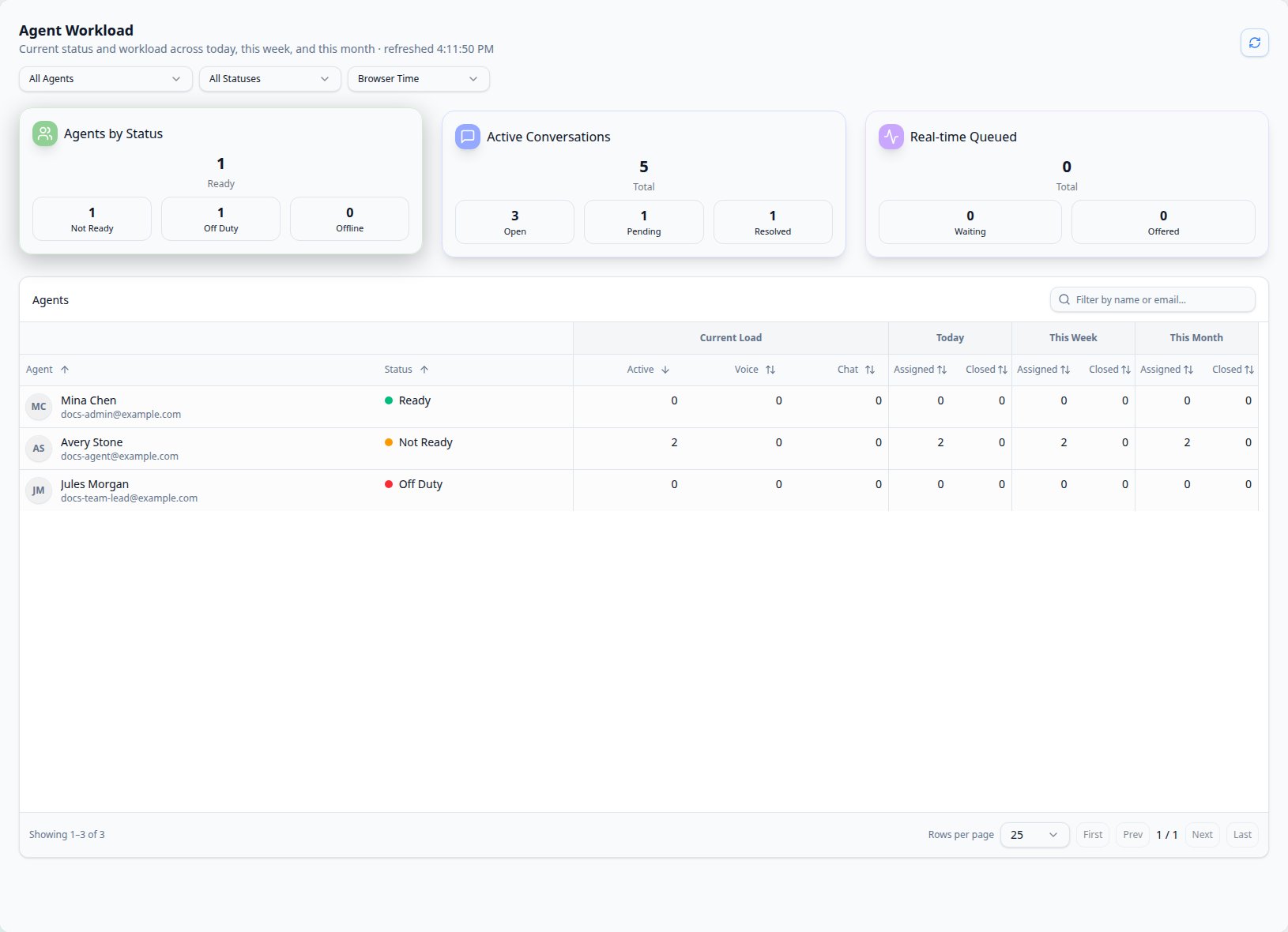
- Agents by Status: Ready, Not Ready, Off Duty, and Offline agents in the selected team scope. Agents without retained runtime state appear as Offline.
- Active Conversations: total non-closed conversations, with Open, Pending, and Resolved counts that add up to the total. When you select a configured team, all three card titles append that team’s name and Active Conversations counts only conversations associated with that team. With All Agents selected, card titles do not include a team suffix.
- Real-time Queued: total conversations currently Waiting or Offered by routing. All Agents sums every routing queue, including the default All Agents queue and configured team queues. Selecting a team scopes this card to that team’s queue only.
Applied Insights
When Applied Insights is enabled for your organization, it provides reusable, custom reporting separately from the fixed operational Dashboard. When it is not enabled, the navigation opens the legacy Crescendo application instead. Depending on your role, you can:- Ask follow-up questions in a private Analyst session without first creating a widget.
- Open tenant dashboards and reusable widgets.
- Preview and export displayed widget results.
- Build or refine widgets with the conversational builder.
- Import reusable widget specifications from the Shared library.
- Publish or unpublish a widget specification when you are an owner or admin.
CX304, select the ID
to open that conversation in CXP and validate the supporting evidence.
References remain selectable when they appear in prose, lists, or table cells.
Only canonical CX followed by a positive number is navigable; older or
synthetic ID formats and fenced code samples remain plain text.
To scope a question to a specific Concierge, type @ followed by the start of
its name anywhere in the composer, then choose it from the menu. CXP replaces
the typed fragment with a name-only inline reference and keeps the cursor in
the same sentence. The menu and pill do not expose internal IDs. The stable
identity stays attached silently to the message even when multiple Concierges
have similar names.
When an investigation reveals a concrete AI Assistant quality problem, the
Analyst may show an Optimization Agent proposal card. Review the
finding, choose the target AI Assistant, adjust the goal if needed, and select
Start Optimization Agent, or select Not now. Nothing starts
automatically. The proposal stays above the composer while it waits for your
decision, and the Analyst response continues only after you decide. Starting
creates the new Optimization session with the approved goal and a bounded
evidence summary so the agent can verify the finding before proposing changes.
The completed proposal remains linked to its Optimization session. The
Analyst conversation shows a New Optimization Agent session created
receipt with a link to open it, and the Optimization workspace shows a link
back to the source Analyst conversation. Starting the session does not
automatically publish or apply changes to the AI Assistant.
Common workflows
Use Search and Reporting to:- Find a prior conversation before replying.
- Review unresolved or pending work.
- Identify high-priority trends.
- Compare AI-handled and human-handled work.
- Review current agent availability, directly assigned work, and routing queues.
- Investigate a customer satisfaction trend.
- Continue a private data investigation across multiple questions.
- Investigate a widget finding without treating it as a confirmed root cause.
- Continue a confirmed finding in Optimization Agent.
- Reuse a shared widget specification without sharing customer data.