

Work conversations
The Conversations workspace is where agents handle customer issues across chat, email, voice, and related follow-up.Prerequisites
Before you work conversations:- You can sign in to the correct tenant.
- Your user has permission to view conversations.
- You are assigned an agent role if you need to receive routed work.
- You are Ready when you want to receive new routing offers.
Use views to find work
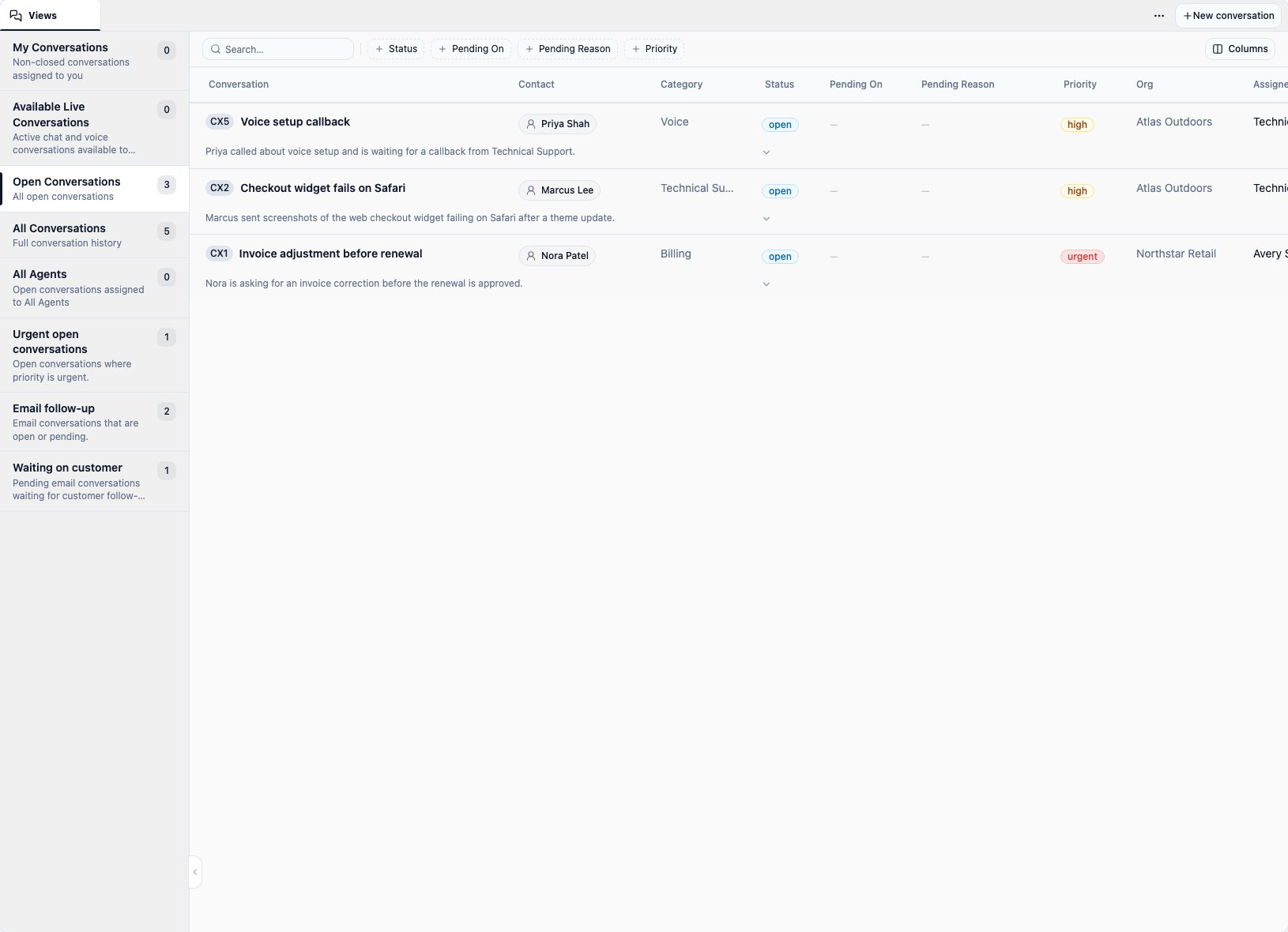
The Views tab shows conversation lists. Common views include:- My Conversations for work assigned to you.
- Available Live Conversations for live work that can be opened without a routing offer.
- Open Conversations for active tenant work.
- Team views for teams you belong to.
- Shared or personal views configured by administrators.
Open a conversation
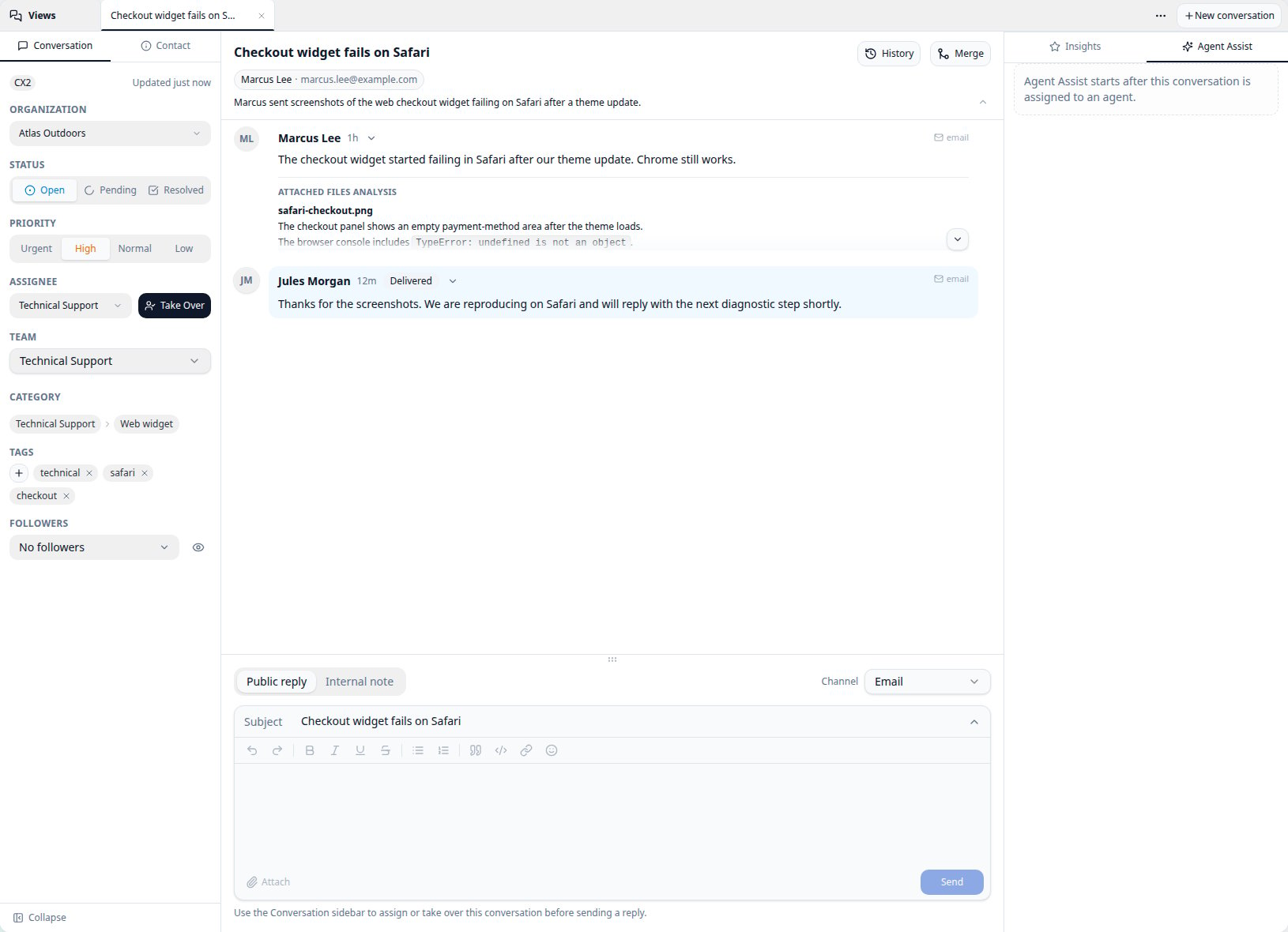
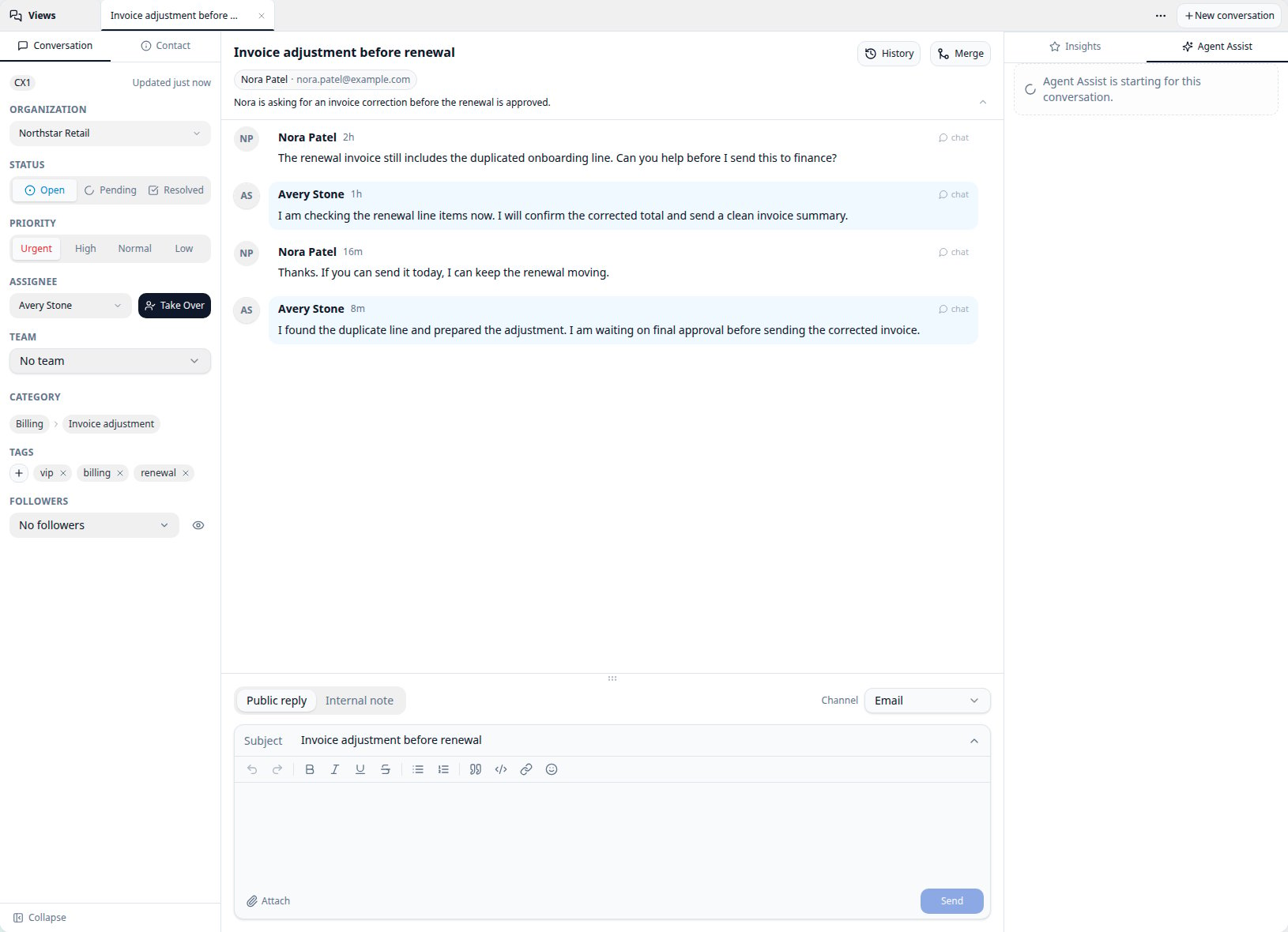
Selecting a row opens the conversation in a workspace tab. Conversation tabs stay inside the CXP app, so you can keep several conversations open without using browser tabs. Select the contact name or email beneath the conversation subject to open that customer’s Contact 360 record as another workspace tab. Your conversation tabs remain open and continue receiving activity while you review or edit the contact. When another open conversation receives customer activity, its tab shows a red unread marker. Notification cues are enabled by default and can play a short message sound when that background marker first appears; the active conversation stays silent. Browser-tab attention also stays on while any conversation tab has a red unread marker. You can change cue, sound, and browser-tab attention settings in My Profile. The detail workspace includes:- Conversation summary and customer context
- Timeline of messages, events, and channel activity
- Status, priority, category, tags, assignment, associated team, and custom fields
- Contact context
- Realtime media handling, Agent Assist, and CSAT in the right rail
- Channel-specific composers or controls when available
Accept routed work
When CXP routes live work to you, an incoming offer appears in the app shell. You can:- Accept to take ownership.
- Decline to return the work to routing.
Assign a conversation
Open Assignee to choose from a team-and-agent hierarchy. All Agents contains every active agent, and each configured team contains its active members. An agent can appear in more than one team. Select either a team or an agent under a team, then select Update to apply the change; closing the dialog before Update discards the draft selection. Selecting an agent under a configured team records both the agent assignment and that team association. Selecting an agent under All Agents assigns the agent without an associated team. Selecting a team row assigns the conversation to that team. Use the separate Team control to change the association without changing the current assignee, or choose No team to clear it. Search matches both team and agent names. A matching agent remains visible under every team where that agent belongs.Update lifecycle
Use conversation status to reflect the current state:- Use Open for active work.
- Use Pending when waiting on the customer, another party, or a configured reason.
- Use Resolved when the issue appears solved but should remain reopenable.
- Use Closed when the conversation is finalized.
Correct the conversation contact
If a conversation is associated with the wrong customer, open Contact in the left controls rail and select Change Contact. CXP initially shows the ten contacts updated most recently. Search by name, email address, or phone number, choose a result, and then select Select. If the customer does not have a contact yet, use Create New; CXP assigns the new contact after it is created successfully. In Simple conversation mode, a contact can have only one non-closed conversation. If the selected contact already has one, CXP leaves the current conversation unchanged and tells you which conversation to merge into. In Advanced mode, the contact change proceeds even when the contact has another non-closed conversation. The reserved Anonymous contact is not available in the selector. When the current conversation is still anonymous, the Contact tab shows only anA
avatar and Anonymous until a real contact is assigned.
Merge duplicate conversations
If two active conversations represent the same customer issue, agents with update permission can merge the current conversation into another conversation. Use Merge from the conversation detail header, search for the target conversation, review the warning, and confirm. Merge is not reversible. CXP adds an internal merge note to the target, then copies customer, agent, assistant, and internal-note history after that note. If the source has a summary, CXP carries it into the target summary; if the target has no subject, CXP uses the source subject. The source conversation is closed with its own merge note, and merge-note conversation links open conversation tabs inside the same CXP browser tab. If the source conversation is Open and the target is Pending or Resolved, CXP reopens the target to Open as part of the merge. This also applies when a returning customer’s new web chat is automatically merged into their existing non-closed conversation.Reply and take notes
For an Open conversation, Public reply offers only the channels that can currently reach the contact:- Email is available when the contact has a primary or secondary email address.
- Chat is available only while the conversation has an active chat interaction and you are its connected Handler.
- Send public replies.
- Add internal notes.
- Reply to email with editable recipients.
- Include email attachments.
- Attach allowed files to an active web chat, or paste, select, and drop allowed images.
- Use voice controls for active calls.
Use Agent Assist
When Agent Assist is available for an assigned conversation, it appears in the right rail. You can ask questions about the conversation and review suggested actions. Agent Assist does not send messages to customers. Suggested replies and notes must be reviewed and applied by an agent.Create a manual conversation
If you have conversation creation permission, use New conversation from the Conversations workspace or Contact 360. Manual conversations can capture:- Subject
- Contact
- Organization
- Status
- Priority
- Assignee
- Category
- Summary