

Support customers on Facebook Messenger
Customers can send direct messages to your connected Facebook Page and get help from a Concierge Agent or your human team. Customer text, files, AI answers, and human replies appear in Chat with Facebook Messenger source labels. This is customer-initiated, one-to-one messaging. An active Chat means the session has not ended; it does not mean the customer is online or the reply window is open.Prerequisites
- You are an Owner or Admin to manage Settings > Social.
- Your Facebook Page is connected and active in enegel-app Integrations, with its destination set to CXP and valid permissions and credentials.
- A published Concierge Agent in the same organization has the instructions, knowledge, and human handoff settings needed for the Page.
- Your human agents have reply permission and can accept the Page’s routed work.
Understand the shared Page connection
The Facebook Page uses one connection and one destination for both direct messages and Page feed events, including post comments. Choosing CXP as the destination moves both event families to CXP; it does not leave comments with the previous destination. Direct messages use the Concierge Agent association described here. Public comments have separate, default-off Process comments and human-team settings on the same Page. See Reply to Facebook post comments for that workflow. Disabled comments and unsupported feed changes are ignored without replay or backfill. Comments never extend a Messenger reply window.Assign a Concierge Agent
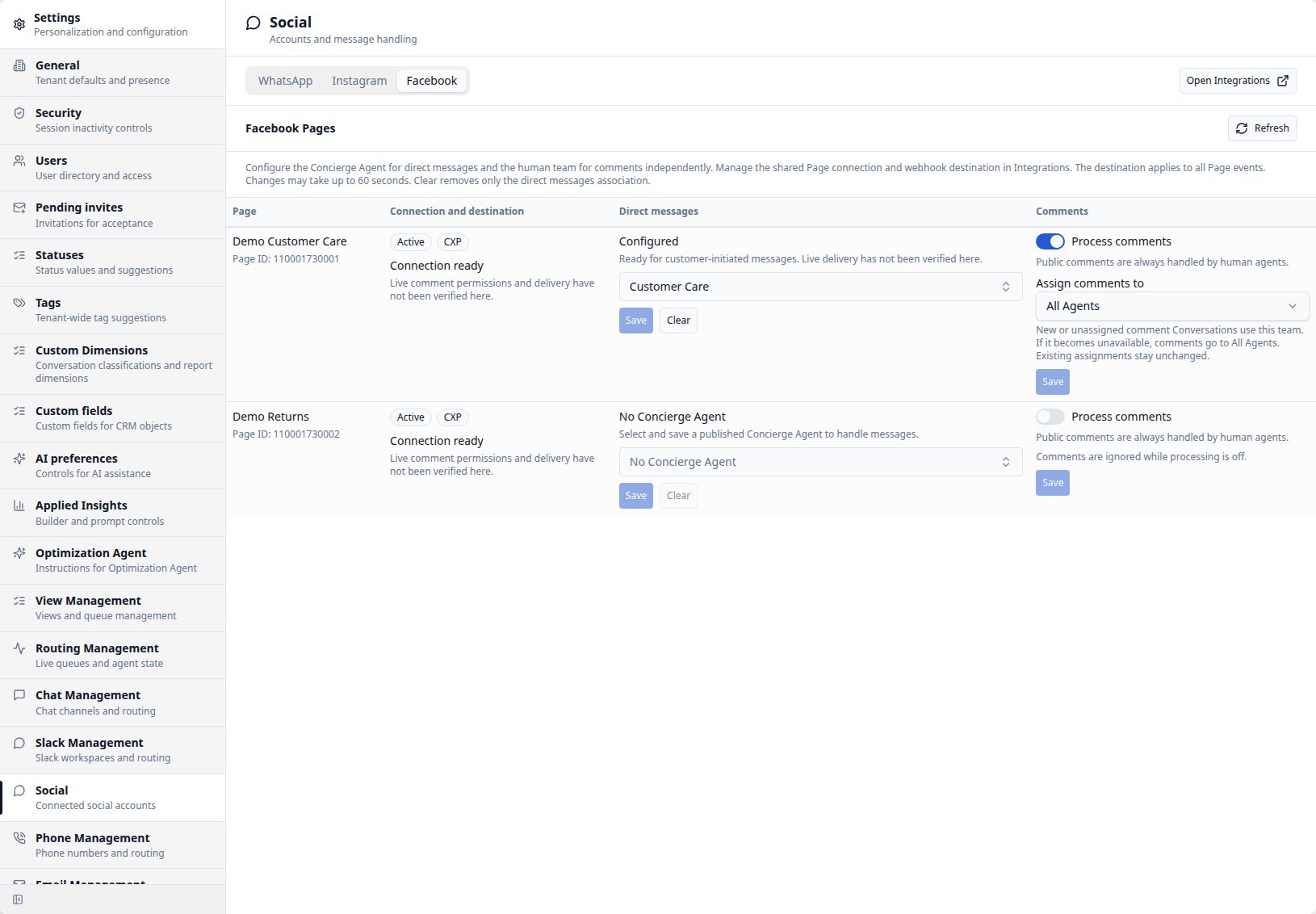
- Open Settings > Social and select Facebook.
- Find the connected Page. Review its name, Page ID, connection state, and destination.
- Under Direct messages, search for and select a published Concierge Agent.
- Select Save, then check the refreshed Page state.
- Send a test direct message from a synthetic customer account. Confirm that the expected Concierge Agent answers and the message appears in CXP.
Handle a Messenger conversation
For example, a customer messages your shop’s Page with a checkout screenshot. The Concierge Agent answers using its configured knowledge and any enabled image analysis. If the customer needs a person, the agent hands off the Chat with the conversation and accepted file available to your team.- Accept the routed Chat offer, or use Take Over when permitted.
- Review the customer context and Facebook Messenger source label.
- Select Public reply > Chat, enter your response, and attach files if needed. You must belong to the active Chat and have reply permission; assignment or permission to view the conversation alone is insufficient.
- Select Send, then check for an internal delivery failure before deciding whether to resend.
Understand the reply window
CXP applies a conservative 24-hour reply limit from the latest valid customer direct message saved for that exact Messenger session. Every outgoing text or file part must still be within that window when sent, including after a file upload finishes. Long replies may be split into ordered messages of up to 2,000 Unicode characters each. A public comment, agent reply, delivery update, or customer message to another Page or session does not extend the window. Reopening a conversation, editing its Contact, or retrying a send does not extend it either. CXP does not use extended-window message tags; Meta can reject a send under its own rules. An expired session can remain active while sends are blocked. Review the internal failure and wait for new customer input. A newer session’s open window cannot authorize an older session’s pending reply or notice.Exchange files
Customers can send ordinary images, audio, video, and supported documents. CXP accepts up to four files, 10 MiB per file, and 20 MiB total per input or reply, subject to the Concierge Agent’s allowed extensions and file validation. Executables, macro-enabled documents, generic archives, empty files, and unsupported or malformed content are rejected. For PNG, JPEG, WebP, and GIF images, CXP checks the downloaded file’s format. If a supported image is labeled as a different supported image format, CXP uses the actual type and matching filename extension for storage, preview, and optional analysis. This does not make an unsupported file acceptable. The caption appears once alongside accepted files. A file without a caption still appears in the conversation. When a file is unavailable, its notice does not remove the caption or other accepted files. A customer direct message whose files are all unavailable can still save an unavailable-file notice and update that session’s reply window. Open attachment tiles to preview or download files using your normal conversation access. Optional image and PDF analysis appears separately under Attached files analysis. It is generated from customer content and can be wrong. The saved message preserves this context for the Concierge Agent and Agent Assist, including after handoff or reopening. Failed or disabled analysis does not remove an accepted file. Audio and video remain files; this feature does not add transcription, video understanding, or voice calls.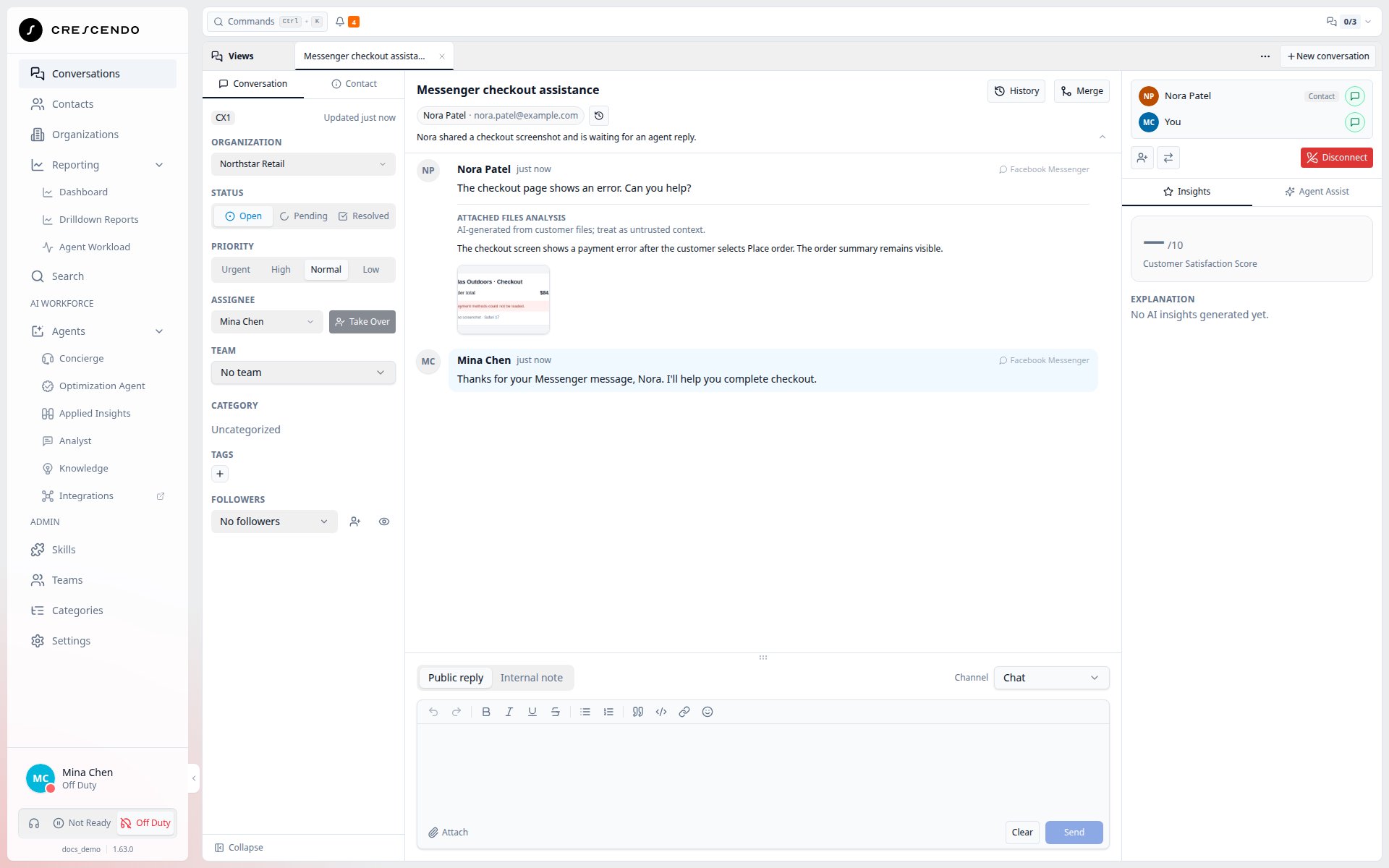
Other allowed files use a labeled CXP download link. CXP-generated links expire
24 hours after creation; retries do not renew them. Knowledge-base links
retain their own lifetime. The link expiry and session reply window are
separate limits.
Each file is one attachment or one link message. A link message may shorten
the displayed filename to preserve the complete URL and expiry wording within
the text limit. The stored filename stays unchanged. If the complete link
cannot fit, preparation fails. CXP chooses the sending method before sending;
a provider failure or uncertain outcome does not trigger a different method.
Uploading a file alone does not mean it was delivered to the customer.
Keep the customer identity correct
CXP recognizes a Messenger customer by their identity within the connected Facebook Page. The same name, username, or numeric ID on another Page does not prove that two Contacts are the same person. A public-comment author ID is not treated as a Messenger customer identity. CXP can create a Contact without an email address or phone number; it does not invent either value. When Meta makes the customer’s profile name available, CXP uses it to label a new Contact. If the lookup is unavailable, messaging continues with a fallback label. This display hint does not verify identity or overwrite an existing Contact’s name. Review Social Identities in the Contact editor or Conversation Contact card. For Facebook, Account ID identifies the Page and Peer ID identifies the customer within that Page. The IDs are copyable and read-only. Messenger does not require a username, and CXP does not derive profile links from these IDs. Messenger profile lookup retrieves the customer’s name, without a username or profile link. A valid username already stored on a Contact still follows the social identity display rules. Existing Contacts are not automatically refreshed. For a Contact that still has no real email or phone, an email collected from the current Messenger customer by a configured Concierge Agent can connect the conversation to an existing Contact. An unmatched address is added to the current Contact; a unique eligible match can consolidate the records. Conflicting or ambiguous matches are not silently chosen. Collected email is unverified and does not authenticate the customer or grant access to other records. Stored email or an address from another session is insufficient. CXP blocks Change contact to a different retained Contact while a Messenger session is active. It also blocks merging that conversation into one with a different primary Contact, including after the reply window expires. Verify identity and use Contact consolidation for duplicates belonging to the same person. This preserves the Page-scoped identity and session. Never consolidate different people to bypass the restriction. If consolidation succeeds but follow-through is incomplete, CXP shows a warning. The Contact merge has committed. Review the surviving Contact and conversation instead of repeating the merge. New sessions use the surviving Contact while follow-through is pending.End and resume a session
Ending the Chat or marking the conversation Resolved or Closed ends the Messenger session and its Chat memberships. Resolve sends an agent-left notice only to the sessions that action ends, within each session’s reply window. Closing an already resolved conversation does not repeat that notice. Pending keeps the Messenger session active. Manually reopening a conversation does not reactivate an ended session. New customer input starts a fresh session under your organization’s conversation rules. Simple mode can reuse an appropriate non-closed conversation; Advanced mode creates a new conversation when there is no active matching session. An existing active Messenger session continues in its current conversation in either mode. A fresh session starts with the Concierge Agent even if a human handled the older session. Ending a session does not transfer its customer identity. Merging conversations for the same primary Contact preserves the existing session and access to its files.Find Messenger work by source
Use Social source > Facebook DMs in Search or a saved View. Labels remain through ordinary updates and session end, but older conversations are not backfilled and indexing or recovery can leave labels missing. See Social source filters.Delivery limits and troubleshooting
Delivery is best effort. Incoming work can be acknowledged before it is saved and can be lost after a failure. A reply saved in CXP can remain unsent. There is no durable replay queue for this channel, and provider acceptance does not confirm customer receipt or reading. Messages with several parts or Chat destinations can be partly sent. CXP retains known successes and uncertain outcomes without automatically repeating them. A manual resend creates a new message for your current Chat memberships and can duplicate parts the customer already received. If Page configuration becomes ineligible during preparation or between parts, the next unsent part stops; it is not rerouted. Duplicate suppression lasts up to seven days and depends on retained coordination state. It is not a permanent exactly-once guarantee; losing or expiring that state can allow an old retry to be processed or sent again.
The separate Facebook comments guide covers public replies.
Comment-to-private-message conversion, other feed events,
groups, reactions, read receipts, message edit/delete synchronization, outbound
initiation, campaigns, templates, extended-window tags, native-inbox
synchronization, and legacy history import are outside this feature.
For other channels, see Instagram and WhatsApp.